September 2026: The Safeguarding Adults Threshold Tool has been reviewed and updated throughout. The guidance and tool seek to support practitioners, partners and providers, working within the adults sector, to report and respond to concerns at the appropriate level and to have a consistency of approach across agencies.
This page contains an accessible, formatted version of the Tool, alternatively a Word version is available: STSAB Multi Agency Risk Threshold Guidance.
CONTENTS
1. Document Context
This Safeguarding Adults Threshold Tool has been reviewed and updated to reflect national learning and good practice. The review has taken into account Local Government Association (LGA) and Association of Directors of Adult Social Services (ADASS) safeguarding frameworks, learning from Safeguarding Adult Reviews, and national guidance on proportionate and person‑centred safeguarding practice.
This update does not change statutory duties or thresholds under the Care Act 2014, but clarifies decision‑making and supports consistent, proportionate responses across partner agencies.
2. Introduction
The Care Act and associated statutory guidance was introduced to ensure an improved and more consistent approach to care and support nationally. Turning the focus onto the person rather than “services”. This threshold guidance builds on the current knowledge and understanding when to refer to the local authority under the safeguarding adults procedures or when another approach is more appropriate. It is imperative that a consistent approach to safeguarding adults practice is developed. Introducing a thresholds guide is one way to improve and develop this.
This guide seeks to support practitioners, partners and providers, working within the adults sector, to report and respond to concerns at the appropriate level and to have a consistency of approach across agencies.
This guidance is not a substitute for professional judgement but should be used to assist decision making and to support professional judgement. The guidance should be used to:
- help determine a consistent approach to identifying what concerns may require a response under the safeguarding process; and
- support decision making when alternative processes should be
Prior to raising an adult safeguarding concern please consider: Does the concern meet the criteria for Section 42 (S42) safeguarding enquiry under the requirements of the Care Act 2014? The requirements are as follows:
- the adult is reported as having or appears to have needs for care; and
- the adult is reported or appears to be experiencing or at risk of abuse; and
- as a result of care and support needs, the adult is unable to protect themselves from either the risk of, or the experience of, abuse or neglect.
PLEASE NOTE: All suspected cases of the following should be reported to the police and adult safeguarding without delay.
Grooming for terrorist activities
Honour Based Crime
Sexual & Criminal Exploitation
Raising a safeguarding concern does not automatically result in a statutory safeguarding enquiry under Section 42 of the Care Act 2014. The local authority has a duty to determine whether the statutory criteria are met and what response is the most appropriate and proportionate. This may include a safeguarding enquiry, or alternative actions through other care, support, quality or commissioning processes.
Responses should be proportionate to the level of risk, focus on preventing further harm, and be informed by the views, wishes and desired outcomes of the adult.
2.1 Has the person given their consent to share information and do they know a S42 enquiry may be the result?
Consent is not essential when deciding whether concerns should be raised. However, wherever possible, practitioners should discuss concerns with the person and/or their representative and seek consent. Where a person is unwilling or unable to freely give consent, practitioners must consider whether there is a risk to the person or to others, including children or adults with care and support needs. In such circumstances, consent may be overridden in the interests of safeguarding. If you remain unsure as to what action to take you should discuss this with your manager or your organisation’s safeguarding lead. Ensure you record all actions clearly with reasons for your decision.
If you remain unsure about what action to take, you should discuss this with your manager or your organisation’s safeguarding lead. All actions and decisions must be clearly recorded, including the rationale for decisions made.
3. Guidance on Categories
3.1 Non reportable
Concerns that do not meet the threshold for a safeguarding enquiry under Section 42 of the Care Act 2014. These concerns may still require action, monitoring, local resolution or alternative processes.
Multiple non‑reportable incidents involving the same person, staff member or team should be considered for consultation, particularly where there are emerging patterns, cumulative harm or escalation. Individual organisations should clearly define their approach in writing (for example, three incidents within a defined period). These examples are indicative and should not replace professional judgement.
NB: This does not apply to Providers under the Provider Concerns Framework; all non‑reportable provider concerns require further consideration.
3.2 Requires consideration
Concerns that require consultation with a Social Worker in South Tyneside’s Adult Safeguarding Team to determine the most appropriate and proportionate response.
NHS Trust staff should consult with their Adult Safeguarding Lead in line with local arrangements prior to contacting the local authority.
3.3 Reportable
Concerns that indicate it is highly likely the criteria for a safeguarding enquiry under Section 42 of the Care Act 2014 are met. These concerns should be reported to the local authority for consideration.
Raising a reportable concern does not pre‑determine the outcome, as the local authority retains responsibility for deciding whether a Section 42 enquiry is required and what response is most appropriate.
4. Care Act 2014
Section 42 of the Care Act 2014 defines an adult at risk as an adult who:
- has needs for care and support (whether or not the local authority is meeting any of those needs);
- is experiencing, or is at risk of, abuse or neglect;
- as a result of those needs, is unable to protect themselves from either the risk of, or the experience of, abuse or neglect.
The Local Authority retains responsibility for overseeing a safeguarding enquiry and ensuring that any investigation satisfies its duty under Section 42 to decide what action (if any) is necessary to help and protect the adult, and to ensure that such action is taken when necessary.
The Care Act 2014 recognises a range of categories of abuse and neglect, including, but not limited to, Female Genital Mutilation, Modern Slavery, Self‑neglect, Honour‑Based Abuse and Domestic Abuse. It should be noted that these categories may overlap and present within other forms of abuse or neglect.
Section 14.9 of the Care Act Statutory Guidance is clear that safeguarding adults procedures are not a substitute for:
- providers’ responsibility to provide safe and high‑quality care and support;
- commissioners’ responsibilities for regularly assuring themselves of the safety and effectiveness of commissioned services;
- the Care Quality Commission (CQC) ensuring that regulated providers comply with the fundamental standards of care, including taking enforcement action where required;
- the core duties of the police to prevent and detect crime and protect life and property.
The Care Act also places a strong emphasis on the wellbeing principle and makes it clear that an individual’s wellbeing must be at the centre of any interaction with a person. Providers must act to promote wellbeing whenever they carry out any care and support functions.
The Act’s concept of wellbeing is a broad and inclusive one and relates in particular to the following areas:
- personal dignity (including treatment of the individual with respect);
- physical and mental health, and emotional wellbeing;
- protection from abuse and neglect;
- control by the individual over day‑to‑day life (including over care and support provided and the way it is provided);
- participation in work, education, training or recreation;
- social and economic wellbeing;
- domestic, family and personal relationships;
- suitability of living accommodation;
- the individual’s contribution to society.
As the wellbeing principle encompasses several aspects of a person’s life, a holistic approach to understanding the individual’s views, wishes and circumstances is essential. Wellbeing should always be considered when using this threshold document.
5. Principles
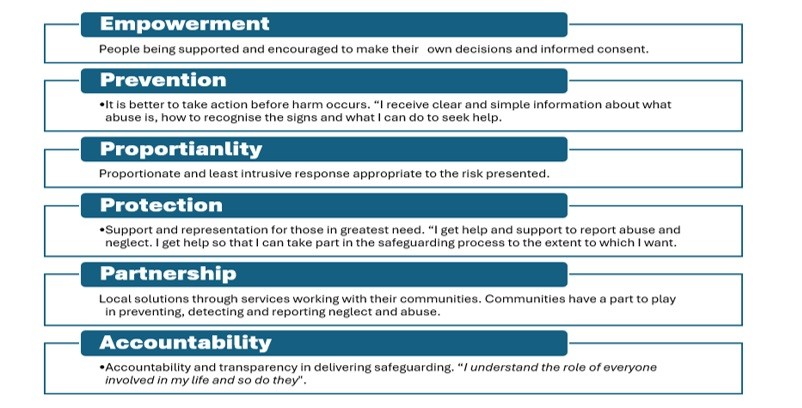
This threshold guidance is underpinned by the 6 principles of safeguarding and the Mental Capacity Act 2005. Making Safeguarding Personal must also be applied in all decision making and must be used by all agencies working in adult provision:
6. Guidance
Threshold decision‑making can be complex and an incident may involve several types of abuse or neglect, all of which must be considered. For example, a medication error could indicate organisational, physical, psychological abuse or neglect. However, a medication error may also be an isolated incident and primarily a quality‑of‑care issue. Consideration should be given to context, history, patterns and cumulative harm.
This Adult Safeguarding Thresholds Guidance is a model to support the management of risk in safeguarding concerns. It should be used in conjunction with providers’ and practitioners’ own multi‑agency procedures and has been developed to:
- offer consistency;
- provide a framework to support multi‑agency decision‑making;
- assist in differentiating between quality issues and safeguarding risk.
The intention of the threshold guidance is to support providers and practitioners to identify the level of response required when a concern is suspected or an incident is recognised. It supports consideration of the type, seriousness and impact of abuse or neglect, and the circumstances in which a referral to Adult Social Care may be required.
Responses must be proportionate, focused on preventing or reducing vulnerability and risk, and promote the wellbeing of adults at risk of abuse or neglect.
This guidance has been agreed by the South Tyneside Safeguarding Adults Board (STSAB) and will be used by all agencies across the public, private and voluntary sectors that deliver adult services.
7. Key Considerations
When determining the appropriate response, practitioners should consider:
- how long has the alleged abuse or neglect been occurring?
- what is the seriousness or impact of the suspected harm on the individual?
- is there a pattern of abuse or repeated incidents?
- have there been previous concerns, including non‑safeguarding issues such as anti‑social behaviour or hate crime?
- have previous actions or plans to mitigate risk been ineffective, or poorly implemented?
- are there any other adults at risk?
- is the situation currently being monitored?
- are incidents increasing in frequency and/or severity?
- are there children or young people (under age 18) present?
- if children are present, consider contacting:
- Integrated Safeguarding Intervention Team (ISIT)
- Telephone: 0191 4245010 (8.30am – 5.00pm Monday to Thursday; 8.30am – 4.30pm (Monday – Friday).
- Out of hours team: 0191 456 2093.
- In am emergency, always call 999.
8. Interface with Safeguarding Children
Where practitioners are working with adults and there are concerns about unborn children, or children and young people living with or in contact with that adult, consideration must also be given to the safety and wellbeing of children using a Think Family approach. Practitioners should follow the South Tyneside Safeguarding Children Multi‑Agency Procedures.
The Safeguarding Adults Referral Form requires information relating to any risks involving children. This does not replace the requirement to follow Safeguarding Children procedures but supports coordination and information‑sharing between agencies. Responsibility for safeguarding children remains with the referring agency.
Concerns about a child or young person can also be raised directly with the ISIT Team. Referrals can be made online using the multi agency referral form.
9. Making Safeguarding Personal
Whether concerns are low or high risk, it is essential to consider and record the views of the adult and/or their advocate.
When considering impact, practitioners should understand the individual’s experience and the significance of the harm. Making Safeguarding Personal means responses should be person‑led and outcome‑focused, with actions shaped by what matters to the adult. For more information see Making Safeguarding Personal.
10. Responding to Concerns
All incidents must be recorded and managed in accordance with local procedures; however, not all incidents will result in safeguarding actions.
It is important to consider in the first instance whether someone is in immediate danger – or has been the subject of crime.
Criminal acts must be reported to the police and / or emergency treatment should be sought where necessary.
You should always seek advice from your line manager or safeguarding lead if you have a concern and, if in doubt, contact the council’s adult social care team on 0191 424 6000.
11. Threshold Decision Making Guidance
Examples of possible actions are provided at each stage but are not exhaustive. Following any incident, a review should be undertaken and an action plan implemented. A series of similar incidents may, when considered cumulatively, meet the criteria for a safeguarding response.
The Care Quality Commission (CQC) may require evidence of decision‑making processes, internal reviews and actions taken as part of its inspection and assurance activities.
The following Red – Amber – Green (RAG) framework should be used alongside the threshold tool to support proportionate decision‑making in response to safeguarding concerns.
It provides a consistent approach to determining the level of response required, including when concerns can be managed within services, when consultation is appropriate, and when a safeguarding concern should be raised with Adult Social Care.
This framework is intended to support, not replace, professional judgement. Decisions should always take account of the individual circumstances, the impact on the adult, and any patterns or cumulative risk.
| Green | Record the incident and take action to resolve. |
| Yellow | Record the incident, consult own agency safeguarding lead/policies and procedures. Take actions to reduce risk. Consult with Adult Social Care. |
| Red | In addition to the above, raise a Safeguarding Concern with Adult Social Care. |
Examples have been provided of possible actions that should be considered at every stage. These are offered as examples only and should not be considered exhaustive. It is important that following any incident a review should be undertaken and an action plan put in place to ensure lessons are learnt and the risk of the incident being repeated is reduced. It is also important to review all incidents in the context of those previously recorded as a series of similar incidents may meet the criteria for referral into safeguarding.
The CQC, as part of the inspection process, will require evidence of agencies’ decision-making to confirm internal reviews, including subsequent actions, have taken place.
12. Contact Details
Once this Threshold Guidance Tool has been considered in relation to the alleged abuse and/or neglect, the Safeguarding Adults Referral form should be completed and submitted via the secure email to: [email protected]
If you do not have a secure email account, please email [email protected] or telephone the Let’s Talk Team on 0191 424 6000.
Once submitted you will receive an automatic e-mail to confirm receipt into the Safeguarding Inbox. If you don’t receive an e-mail, please telephone Let’s Talk Team to confirm receipt.
13. Threshold Tool
13.1 Types of abuse and neglect and suggested responses
Physical abuse (opens as a PDF)
Sexual abuse (opens as a PDF)
Psychological abuse (opens as a PDF)
Financial or material abuse (opens as a PDF)
Neglect and acts of omission (opens as a PDF)
Organisational abuse (opens as a PDF)
Discriminatory abuse including hate crime (opens as a PDF)
Modern slavery (opens as a PDF)
Domestic abuse (opens as a PDF)
Self-neglect (opens as a PDF)
Pressure ulcer (opens as a PDF) see also Section 14, Pressure Ulcers below.
Falls (opens as a PDF)
People experiencing homelessness (opens as a PDF)
14. Pressure Ulcers
Many people who are frail and have restricted mobility are at risk of developing ulcers on the points of their body which receive the most pressure. These are known as pressure ulcers, pressure sores, bed ulcers or ulcers. Pressure ulcers start with skin discolouration but if left untreated they can become very deep and infected, and in the worst cases they can be life threatening. With management and care, pressure ulcers can be avoided in most cases.
Pressure ulcers are primarily a clinical issue and should be referred to an appropriate health professional in the first instance. However, they can occur through neglect and/or omission of care (whether deliberate or unintentional). Each individual case should be considered, taking into account the person’s medical condition, prognosis, any skin conditions, and other signs of neglect. These can include poor personal hygiene and living environment, poor nutrition and hydration, and their own views on their care and treatment. Pressure ulcers may also be an indicator of neglect or omission of care, particularly where there are concerns about repeated incidents, poor care planning, lack of intervention or deterioration over time.
Staff should refer to their own organisation’s policies and procedures on pressure ulcers; as well as other relevant local and national guidelines, protocols, and policies, e.g., National Institute for Health and Care Excellence (NICE) guidance and incident reporting policies.
The Department of Health and Social Care (DHSC) updated the Safeguarding Adults Protocol for Pressure Ulcers and raising a Safeguarding Concern in January 2024. The protocol provides an adult safeguarding decision guide, body map and concern proforma. This will help the provider to determine if a safeguarding referral should be made to the local authority.
In situations where the person has mental capacity and has refused treatment and prevention strategies, standard clinical and care interventions (e.g., Care Management/Care Plan Approach/Multi-Disciplinary Team) should be considered and implemented where appropriate to manage risk. However, where there are concerns about neglect, omission of care, or significant or escalating risk, a safeguarding concern should be considered without delay.
In situations where a person has mental capacity and declines treatment or intervention, practitioners should ensure:
- clear and evidenced consideration of mental capacity;
- evidence available to show concerns raised and support sought from a relevant professional;
- full discussions with the person and/or their next-of-kin or representative.
Where there are clear indicators of neglect, omission of care or risk of harm, a safeguarding concern should be raised.
Pressure Ulcers are primarily a clinical issue and should be referred to the appropriate health professional in the first instance. However, where there are obvious signs of neglect they should be reported to safeguarding. Whilst not all pressure ulcers are due to neglect (deliberate or unintentional) each individual’s care should be considered, taking into account the persons medical condition, prognosis, skin condition, poor personal hygiene, living environment, nutrition/hydration and their own views on care and treatment.
15. Medication Errors
15.1 Responsibilities and statutory requirements of care providers
Care providers who are commissioned to provide any medication administration service are responsible for ensuring that people who require this service have their medicines at the times they need them and in a safe way.
Care providers must have clear procedures in place which include arrangements for reporting adverse events, adverse drug reactions, incidents, errors and near misses relating to medicines.
These arrangements should encourage local, and where appropriate national, reporting and learning, and promote an open honest culture of safety.
The registered person must protect adults in their service against the risks of unsafe use and management of medicines. This should be by means of appropriate arrangements for the obtaining, recording, handling, using, safe keeping, dispensing, safe administration and disposal of medicines used for the purpose of the regulated activity.
All medication errors should be reported in line with the care provider’s management of incidents policy as soon as possible after the incident.
15.2 Good practice in the management of medication errors
- The organisation must have clear procedures for staff detailing how a medication error should be recorded, including specific processes for controlled drugs and reporting mechanisms to the Controlled Drug Accountable Officer (CDAO).
- All medication errors, including near misses, must be recorded. This record must detail the impact of the error, any immediate action taken, and also record the date, time, and names of staff and adults using the service who are involved.
- The error should be reviewed, and an action plan put in place to ensure lessons are learnt and the risk of the error being repeated is reduced. It is also important to review the error in the context of previously recorded errors since a series of similar incidents may meet the criteria for a safeguarding concern to be raised.
- Where there are systemic failings in a provider’s medication management process which lead to repeated medication errors, consideration should be given as to whether a safeguarding enquiry into organisational abuse is warranted.
- If there are cases of medication being mismanaged recklessly or intentionally, such as the misappropriation and misuse of drugs by staff, these should always be reported.
Mistakes are made by people across the process, from the GP to the pharmacist and care staff. Incidents occur where a person is accidentally given someone else’s medication, given too much or too little of their own medication, given a medication that has been stopped, or given it at the wrong time. Most errors do not result in harm, but mistakes can lead to serious and, in some cases, fatal consequences. Medication errors should always be considered in the context of the person’s overall care, including their health condition, prescribed treatment, and the potential impact of the error.
Incidents meeting the lower-level criteria should, wherever possible, be addressed at a local level with the individuals and professionals concerned. This should be with the aim of promoting positive relationships and an open culture that addresses the underlying issues. Repeated error-making is also a warning that due care is not being taken, even if none lead to harm. Where errors are repeated, poorly managed, or result in harm or increased risk, consideration should be given to whether a safeguarding concern is required.
Please note: Internal online incident reporting processes (such as completing a DATIX for those working within acute health services) should still be completed for monitoring purposes. Where a one-off incident or error made is by an agency worker, the agency should be informed as the agency may hold other information regarding errors made elsewhere by the same person.
15.3 Medication error threshold tool
Maladministration of medication (opens as a PDF)
16. Incidents between Adults in a Service
Incidents between adults in a service can include any interaction involving two or more adults in any setting, involving physical, psychological/emotional, sexual, financial, or discriminatory abuse or behaviour, which results in the risk of abuse or neglect, or actual abuse or neglect.
Not all incidents between adults in a service will require a safeguarding concern to be raised. Agencies should follow their own internal incident policies and procedures, ensuring that incidents are managed appropriately and proportionately. Each situation should be considered on its own merits, with professional judgement applied. Particular consideration should be given to patterns of behaviour, vulnerability, and whether one individual is at risk of harm from another.
A degree of conflict on occasions is to be expected in all relationships. This applies equally to environments where people with care and support needs live together or spend long periods of time together. There may be times when the actions of one adult in a service towards another goes beyond usual conflict and their behaviour is abusive, causing an impact.
16.1 Threshold tool
Incidents involving another person with care and support needs (opens as a PDF)
17. Responsibilities of Care Providers
Preventing incidents between adults in a service from occurring wherever possible is always the preferred approach. Those in receipt of services should expect to be supported or cared for in a safe environment. Abuse by other adults in the service who also have care and support needs themselves is just as impactful as any other form of abuse. Provider services should ensure that interventions and support arrangements are in place to minimise the risk of abuse between adults using their service.
Where there are systemic failings in a provider’s management processes which lead to repeated incidents between adults in that service, consideration should be given as to whether a safeguarding enquiry into organisational abuse is warranted. There is an obligation on all services involved to identify such failings and ensure that safeguarding concerns are raised where necessary, and that issues are addressed. Where concerns relate to service quality or systemic issues, appropriate quality assurance or commissioning processes should also be considered alongside safeguarding.
Considering whether patterns of incidents, escalation of behaviour, or impact on individuals indicates the need for a safeguarding concern to be raised.
18. Good Practice in the Management of Incidents involving Adults in a Service
- Having robust and comprehensive pre-admission assessment arrangements to establish an individual’s previous and current needs. This should include consideration to building and maintaining relationships with others, vulnerability, and any behaviour which may challenge, including bullying.
- Considering the potential impact, where appropriate, on existing adults in the service prior to the placement or person starting to use the service and keeping the compatibility of all adults in that service under review.
- The inclusion of anti-bullying, issues of inappropriate interactions between adults in the service and between staff and adults, being included in relevant policies and procedures.
- Promoting a positive culture of mutual respect where individual rights and responsibilities are discussed with adults in the service, and the Mental Capacity Act principles of least restrictive practice are followed and confirmed in the service’s documentation.
- Understanding how to support adults who are involved in incidents through the assessment of needs and risk, and mitigating the risks to both, and linking them in with appropriate support services.
- Care and support plans directing staff on how to promote the safety of adults in their service.
- Having measures in place to positively support those with known behavioural difficulties.
- Ensuring that staff have appropriate training and know who to identify, record and review incidents involving adults in the service.
- Ensuring that staff numbers are sufficient to meet the needs of the adults in the service.
- Following the agency’s notification procedures including, where appropriate, informing the adults’ families or nominated representatives.
- Ensuring that measures are in place to secure the safety of people within or visiting the the service.
19. Post Incident Reviews
- When an incident occurs between adults in a service, the details should be recorded to identify any potential patterns. The information as a minimum should record the incident date and time, the adults involved, members of staff on duty, and the circumstances immediately prior to the incident and any other relevant information.
- Reviews should consider the impact on the adult involved, including their safety, wellbeing and outcomes, in line with Making Safeguarding Personal principles.
- Reviews of risk assessments and care plans should always be undertaken following each incident.
- Senior managers should review post incident information on a regular basis to determine whether certain adults are regularly involved, either as the victim or the person who is the cause of risk, and the staff on duty at the time.
- Reviews should consider lessons learnt, whether the incident could have been prevented, and the need for changes to avoid similar incidents recurring.
- Where post‑incident reviews identify patterns, increased risk, or indicators of abuse or neglect, a safeguarding concern should be considered.